Addenda List
An Analytical Outline of Hebrews - D. A. Carson
I. Introduction: God’s
Final Word to Us in His Son, 1:1-4 and Better than the Prophets
II. Jesus Better than
the Angels, and the Ultimate Man, 1:5-2:18
A. Jesus the Son of God Better than the Angels, 1:5-14
B. Embedded
Warning: Do Not Turn Away from the Word Spoken by God’s Son, 2:1-4
C. The Son Temporarily Lower than the Angels, 2:5-9
D. The Son Identifying with and Suffering for the Sons, 2:10-18
III. Jesus Better than
Moses, 3:1-6
IV. Jesus and the
Sabbath Rest, 3:7-4:13
A. A Moralizing Reading of Ps 95: Persevere or Perish, 3:7-19
B. A Typological Reading of Ps 95: Understanding the Ultimate Rest,
4:1-13
(1) The Typological
Chain of Events and Their Meaning, 4:1-11
(Jesus Better than Joshua)
(2) The Power of the
Word of God, 4:12-13
V. Jesus the Great High
Priest, 4:14-7:28
A. Pastoral
Implications of Having Such a High Priest, 4:14-16
B. The Son’s Appointment
as Unique High Priest, 5:1-7:28
(1) Survey Statement:
The Son’s Unique Qualifications, 5:1-10
(2)
Embedded Warning: The
Danger of Apostasy, 5:11-6:12
(a) Spiritual
Immaturity, 5:11-6:3
(b) Stern Warning Regarding Apostasy, 6:4-8
(c)
Encouragement to Persevere, 6:9-12
(3) The Stellar
Certainty of God’s Promise Our Ground of Hope, 6:13-20
(4) The Place of
Melchizedek in Redemptive History, 7:1-10
(5) The Superiority of Jesus as
Melchizedekian High Priest, 7:11-28
(Jesus Better than
Aaron)
VI. The Superior
Ministry of Jesus the Appointed High Priest, 8:1-10:18
A. The Superior
Ministry of the Heavenly High Priest, 8:1-6
B. The Superiority of the New
Covenant, 8:7-13
C. The Superiority of the New Covenant Offering, 9:1-10:18
(1) A Study in
Contrasts, 9:1-14
The Old Covenant
Sanctuary, 9:1-5
The Old Covenant Offering, 9:6-7
The Old Covenant
Approach, 9:8-10
The New Covenant Place, 9:11
The New Covenant Offering,
9:12
The New Covenant Approach, 9:13-14
(2) Christ the Mediator
of the New Covenant, 9:15-22
(3) Christ’s Perfect
Sacrifice, 9:23-28
(4) Shadow and Reality, 10:1-4
(5) The Temporary and
the Final, 10:5-18
VII. Pastoral
Application in the Light of Christ’s Superiority, 10:19-25
A. Let Us Draw Near to
God, 10:19-22
B. Let Us Hold Unswervingly to the Hope We Possess, 19:23
C.
Let Us Encourage One Another, 19:24-25
VIII. Perseverance and Faithful Endurance, 10:26-12:29
A.
Embedded Warning Against
Apostasy and an Exhortation to Perseverance, 10:26-39
(1) Stern Warning,
10:26-31
(2) Encouragement to Remember and Persevere, 10:32-39
B. A Catalog of Old
Testament Faithful Endurance, 11:1-40
(1) Faith in the
Unseen: The Ante-diluvians, 11:1-7
(2) The Patriarchal Period, 11:8-22
(3)
The Exodus, 11:23-29
(4) The Conquest of Canaan and the Period of the Judges,
11:30-32
(5) The Exercise of Faith in Victors, 11:33-35a
(6) The Exercise
of Faith in Victims, 11:35b-38
(7) The Expectation of Faith, 11:39-40
C. Practical
Application, 12:1-29
(1) Running with
Endurance, Fixing Eyes on Jesus, 12:1-2
(2) Enduring Discipline from Our
Heavenly Father, 12:3-17
(3) Rejoicing in Your Identity in the Church of
Heavenly Zion, 12:18-24
(4) Warning Not to Reject the One Who Speaks from
Heaven, 12:25-29
IX. Concluding
Exhortations, Prayers, and Greetings
A. Confidence in God
and the Abolition of Selfishness, 12:1-6
B. Instructions for the Church,
13:7-19
C. Prayer and Doxology, 13:20-21
D. Notes, Greetings, Benediction,
13:22-25
A Simple Timeline - "Eternity Past Till Now," AncientPath
Eternity Past - Triune God Eternal
The Decrees of God
Physical Creation [Universe]
Angelic Realms
Creation Narrative concerning God and Mankind
Adam & Eve
The Fall of Mankind
Cain and Able
Seth takes Able's place
The first human culture
The Failure of the first human culture -
The failure of the spread human cultures
The Great Flood
Noah
-2165 - Abram Born
God calls Abram (Gen.12.4) The definition of Faith
(believing God, obeying God as a result)
-2090 Abram enters
-2065 - Isaac born
-2050 - Isaac is taken to Mt Moriah by Abraham
-2005 - Jacob & Esau Born
-1897 - Joseph sold into slavery in
-1792 - Hammurabi rules in
-1730 - Hyksos invade Egyupt (new king who knew not Joseph)
-1525 - Birth of Moses
-1445 - Passover and the Exodus from
-1405 -
-1391 - The Time of The Elders
-1390 - The Time of The Judges
-1105 - Birth of Samuel
-1050 - Saul becomes King
-1011 - David become King of Judah
-1004 - David becomes Full King of united nation of
-971 - Solomon becomes King
-950 - Damascas comes to power
-931 - The
-886 -
-733 - Tiglath-Pileser III of
-640 -
-586 - Nebuchadnezzar of
-580 -
-536 - 1st delivery from
-442 - Walls of
-400 - 400 years of silence from God begins
-350 -
-320 - Alexander the Great is dead at 32 yrs
-165 - The Maccabean Revolt -
-130 -
-60 - Julius Caesar
-48 - Marc Antony rules
-4 - John The Baptist
-3 - Jesus Is Born
27 - Jesus 1st miracle @
29 - John the Baptist beheaded
29 Fall - The Transfiguration
30 Spring - Jesus Crucified, dead, buried, resurrected,
ascended
30 early summer, late spring Pentecost
67 Book of Hebrews written
70 The Destruction of
100 Death of the Apostle John - End of the Apostolic age
330 Emperor Constantine embraces Christianity
350 East and West Catholic church split
476 Fall of the
570 Muhammad Ibn Abd Allah is born in
1350 The Renaissance
1492
1517 Martin Luther Born Again
1611 KJV published
1850 Karl Marx, Charles Darwin
1914 WWI
1939 WWII
1947 Jewish War of Independance - The formation of the
Jewish State - Israel Reborn
1964 The Palestine Liberation Organization created
1967 The "Six Day War"
1973 The Yom Kippur War
The Eternal Kingdom of God - Chart
J. Dwight Pentecost
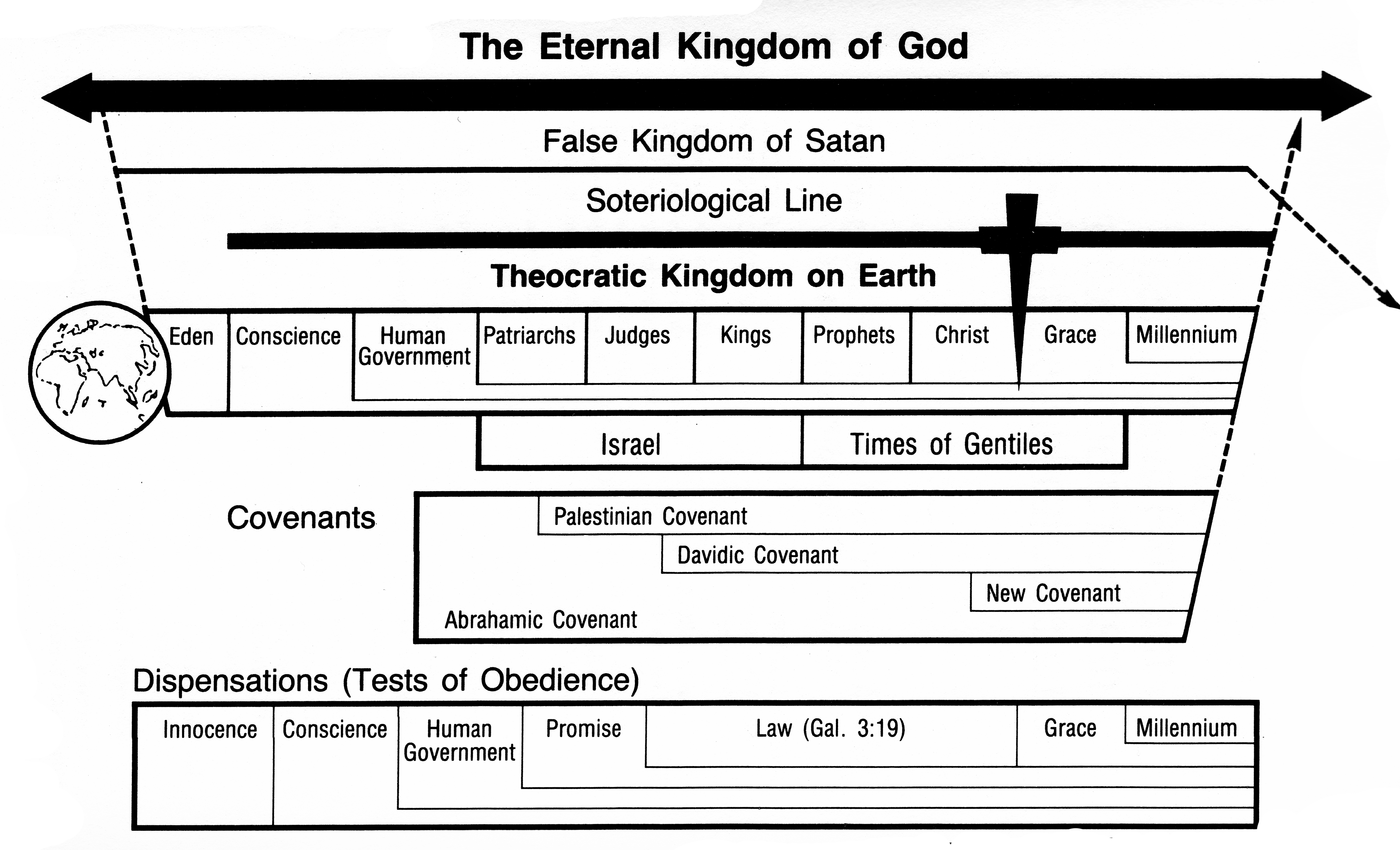
See Hebrews Chapter 1 Flowchart
Some Accomplishments of Jesus, The Son of God
1 Corinthians 15:20-28
What was accomplished
before the Incarnation
Philippians 2:5-11
5
Have this
attitude in yourselves which was also in Christ Jesus,
6
who, although He
existed in the form of God, did not regard equality with God a thing to be
grasped,
7
but emptied Himself,
taking the form of a bond-servant, and being made in the likeness of men.
8
Being found in
appearance as a man, He humbled Himself by becoming obedient to the point of
death, even death on a cross.
9
For this reason also,
God highly exalted Him, and bestowed on Him the name which is above every name,
10
so that at the name of
Jesus every knee will bow, of those who are in heaven and on earth and under the
earth,
11
and that every tongue
will confess that Jesus Christ is Lord, to the glory of God the Father.
What He has already
accomplished and is accomplishing
1 Corinthians 15:20-23
20
But now Christ has been
raised from the dead, the first fruits of those who are asleep.
21 For since by a man came
death, by a man also came the
resurrection of the dead.
22 For as
in Adam all die, so also in Christ all will be made alive.
23
But each in his own order: Christ the first fruits, after that those who are
Christ’s at His coming,
What He has yet to accomplish
1 Corinthians 15:24-28
24
then comes
the end, when He hands over the kingdom to the God and Father, when He has
abolished all rule and all authority and power.
25 For He
must reign until He has put all His enemies under His feet.
26 The last enemy that will be abolished is death.
27 For He has put all things in subjection under His feet. But when
He says, “All things are put in subjection,” it is evident that He is excepted
who put all things in subjection to Him.28
When all things are subjected
to Him, then the Son Himself also will be subjected to the One who
subjected all things to Him, so that God may be all in all.
F. B. Huey's introduction to the book of Hebrews
As I have studied this book it has become more and more obvious that my theology has been molded by Paul’s. It is very difficult for me to allow the plurality of the other NT authors to present their inspired thoughts because I tend to put them into Pauline categories. This is particularly evident in the emphasis of Hebrews on continuing in the faith. In the book of Hebrews faith is not a forensic position (justification by faith), but a faithful life to the end (chapters 11-12). I am afraid that many of the questions I struggle with in Hebrews would have never been asked by its author (nor Peter, nor James). Hebrews is an occasional document, like all the NT books. I must let the author speak even when he/she makes me uncomfortable; even when he/she does not use my cherished categories or even radically disrupts those categories. I dare not substitute my systematic theology for an inspired NT author’s message. I prefer to repent of my theological dogmatism and live within a NT tension that I do not fully understand or like! I am afraid I view the NT through the filter of a modern evangelical, conventionist grid. I want to affirm biblical promises; promises of God’s love, provision, and keeping power; yet I am convicted by the powerful warnings and mandates of the NT authors. I desperately need to hear Hebrews, but it is so painful! I want to explain away the tension. I suppose, in reality, I want to affirm a free salvation and a cost-everything Christian life. But where do I draw the line when the ideal is not met? Is eternal fellowship with God an initial faith response or a continuing faith response? Hebrews clearly states the mandate of a continuing faith response. The Christian life is viewed from the end, not the beginning (cf. chapter 11)! This is not meant to imply a works-oriented salvation, but a works-oriented confirmation. Faith is the evidence, not the mechanism (which is grace). Believers are not saved by works, but unto works. Works are not the means of salvation, but the result of salvation. Godly, faithful, daily Christlikeness is not something we do, but who we are in Him. If there is no changed, and changing, life of faith there is no evidence, no security. Only God knows the heart and the circumstances. Assurance is meant to be a companion in a life of faith, not an initial theological assertion devoid of lifestyle evidence.
The Big List of Prophets
A Big List of Prophets From The Bible
BY JACK WELLMAN
Here is a nearly comprehensive list of the major prophets (34) in the Bible.
Introduction
You probably know most of the prophets in the Bible like Isaiah, Ezekiel, Jeremiah, and many others but there were a lot more prophets than you might first think but first of all, what does the word prophet mean? It doesn’t actually specifically mean predicting the future but it comes from the Hebrew word “nabiy’” and means “spokesman” or “speaker.” In the Greek the word for prophet is “prophetes” and means several things; it is a “forth” (pro) “telling” or teaching (phetes) and an interpreter of the oracles of God and when God’s Spirit solemnly declares to men what he has received by inspiration, especially concerning future events and he either speaks them or writes them down. There are Major Prophets and Minor Prophets but they are not major and minor due to their significance but this refers only to the size of each book.
Abel
Abel may have been the very first prophet and that’s how Jesus refers to him by saying “from the blood of Abel to the blood of Zechariah, who perished between the altar and the sanctuary. Yes, I tell you, it will be required of this generation” (Luke 11:51) thereby classifying Abel as a prophet. The context clearly shows that Jesus was talking about the religious leaders (Luke 11:42-50).
Abraham
When Abimelech nearly took Abraham’s wife for himself, the Lord warned him that this woman is the wife of a prophet (Gen 20:3-4) but knew it was not Abimelech’s fault (Gen 20:6) but God still told him “return the man’s wife, for he is a prophet, so that he will pray for you, and you shall live. But if you do not return her, know that you shall surely die, you and all who are yours” (Gen 20:7).
Amos
Amos is one of the twelve Minor Prophets and preached against the Northern Kingdom, Israel, and wrote during a time of relative peace and prosperity but neglect of religion, similar to what it is in America, Europe, Australia, and Canada.
Anna
Luke informs us that “there was a prophetess, Anna, the daughter of Phanuel, of the tribe of Asher” (Luke 2:36) and she had been “waiting for the redemption of Jerusalem” (Luke 2:38b) and like Simeon (Luke 2:34-35) saw the redemption come in the Redeemer.
Daniel
Another of the Minor Prophets but there’s nothing minor about the Book of Daniel. Taken into captivity as a very young teen, he stood on his biblical foundation and never deviated from God’s Law, even at the threat and attempts of death.
And-what-more-shall-I
David
If you only read Psalm twenty-one, twenty-two, and twenty-three, you’ll be convinced that David was a prophet which is part of the reason he ends up in the “Hall of Faith” in Hebrews 11:32 where the author writes, “And what more shall I say? For time would fail me to tell of Gideon, Barak, Samson, Jephthah, of David and Samuel and the prophets.”
Deborah
During the times of the Judges, when once again Israel cried out for deliverance, “Deborah, a prophetess, the wife of Lappidoth, was judging Israel at that time” and this courageous woman of God led Israel to victory by prophesying to and encouraging Barak, “Up! For this is the day in which the Lord has given Sisera into your hand. Does not the Lord go out before you” (Judges 4:14) and “not a man was left” (Judges 4:16).
Elijah
Elijah is one of the best known prophets to the Jews because they were expecting Elijah to return someday (Malachi 4:5-6) as Elijah was taken up to heaven and apparently, never tasted death (2nd Kings 2:11-12).
Elisha
Elisha took up the mantle of Elijah’s ministry and asked for a double portion of Elijah’s spirit (2nd Kings 2:9) and Elisha ends up doing twice as many miracles as did Elijah.
Enoch
Most people might not be aware that Enoch, who was said to have walked with God, (Gen 5:24), was also a prophet as Jude writes “Enoch, the seventh from Adam, prophesied about them: “See, the Lord is coming with thousands upon thousands of his holy ones to judge everyone, and to convict all of them of all the ungodly acts they have committed in their ungodliness, and of all the defiant words ungodly sinners have spoken against him” (Jude 1:14-15) apparently from the Jewish “Frist Book of Enoch.”
Ezekiel
Ezekiel revealed prophecies regarding the destruction of Jerusalem but also the restoration of Israel in his “Temple Visions” while in exile in Babylon.
Habakkuk
Habakkuk the Prophet is the eighth of the twelve Minor Prophets and we don’t know he original name and nearly nothing is known of his background or life.
Haggai
Haggai is yet another of the Minor Prophets and like Habakkuk, precious little is known about him and even his name may not be his actual name because Haggai means “my holiday” referring to God.
Hosea
Hosea’s name means “salvation” but is often seen as the “prophet of doom” but the Jews but actually under all of the “doomsday” prophecies, he gives the reader a hint of the coming restoration of Israel.
Hulda
Huldah was also a prophetess of God and the king, the priest, and other important men went to her to inquire of God.
Isaiah
Isaiah the Prophet, whose name literally means “Yah is salvation” was one of Jesus’ favorite readings in the Temple and told of the Messiah’s coming suffering (53) and is very much a book about Jesus.
Jeremiah
Jeremiah, the so-called “weeping prophet” was, like Isaiah, one of the Major Prophets and warned Judah time and again about the coming destruction of Jerusalem and captivity of the Jewish people. God had Jeremiah warn the nation, even though God said that they would not listen (Jer 2:30; 5:3; 6:17).
Jesus
Jesus has been described as a teacher and prophet, even though He is the Son of God and fully God. If you read Matthew chapters twenty four and twenty five, you can clearly see He prophesied about the end times.
Joel
Joel, one of the twelve Minor Prophets, prophesied about the day when God would pour out His Spirit upon all flesh and that they would speak prophecies and have dreams and visions (Joel 2:28-29).
John the Baptist
Who was the last prophet from the Old Testament? Was it Malachi? What is Habakkuk? No, the last Old Testament prophet was John the Baptist who came in the spirit of Elijah (Luke 1:16) and was the prophet where the Old Testament overlapped and ran into the New Testament.
John
The Apostle John was not so much a prophet as he was charged with recording a prophecy, the Book of Revelation but was actually not His revelation but was the revelation of Jesus Christ (Rev 1:1).
Jonah
Jonah, the prophet who tried to run away from God’s call to witness to Nineveh was one of the Minor Prophets who prophesied primarily to the Northern Kingdom, Israel.
Malachi
Malachi, the last prophet of the Old Testament wrote about the coming of one who would prepare the way for the coming Messiah in the spirit of Elijah and that was about John the Baptist, who fulfilled the prophecy.
Micah
Micah, whose name means “who is like God?” was also a Minor Prophet and a contemporary of Amos, Isaiah, and Hosea who directed his prophecies specifically to Jerusalem and like all the prophets, his warnings were ignored.
Miriam
Miriam was the sister of Aaron but she was also a prophetess (Ex 15:20) and also a songwriter too (Ex 15:20) and even though she and Aaron spoke against Moses, even a prophetess is not above sin.
Moses
Moses was a prophet and not just the religious leader of Israel but also the Lawgiver. Moses prophesied of the coming One Who “God will raise up for you a prophet like me from among you, from your brothers—it is to him you shall listen” (Duet 18:15) and whoever rejects Him, rejects God (Duet 18:18-20).
Nahum
Nahum is a little known Minor Prophet who, chronologically, has his book come between Micah and Habakkuk and prophesied about the coming end of the Assyrian Empire and the fall of their chief city, Nineveh.
Nathan
Nathan the Prophet was the prophet that King David typically consulted and of course Nathan is the one who said “You are the man” (2nd Sam 12:7)!
Obadiah
Obadiah is also a Minor Prophet whose name means “servant of God” and looked forward to the end of the captivity that Judah was in at the time.
Samuel
Samuel the Prophet was grieved when Israel asked for a king but God knew it wasn’t Samuel they were rejecting but Him (1st Sam 8:6). God used him in the anointing of the Israel’s first two kings (Saul and David) and in communicating God’s will for these kings.
Saul and Barnabas
Yes, I believe that these two men were prophets in the sense of preaching the gospel and warning those who reject Christ. Acts 13:1 says “Now there were in the church at Antioch prophets and teachers, Barnabas, Simeon who was called Niger, Lucius of Cyrene, Manaen a lifelong friend of Herod the tetrarch, and Saul.” Teachers are “forth” or “truth tellers” and so they can be both a teacher and a prophet and this verse seems to indicate that they were.
Simeon
Simeon too was a prophet for he prophesied “and said to Mary his mother, “Behold, this child is appointed for the fall and rising of many in Israel, and for a sign that is opposed (and a sword will pierce through your own soul also), so that thoughts from many hearts may be revealed”(Luke 2:34-35).
Zechariah
Zechariah is one of the Minor Prophets too and whose name means “God has remembered” and is very fitting because He was a prophet of Judah and was of the priestly line, just as Ezekiel.
Zephaniah
The last in alphabetical order, Zephaniah was a Minor Prophet but there was nothing minor about his prophecies as his name meant “concealed of God” and was a contemporary of Jeremiah the Prophet and also prophesied to the nation of Judah.
Conclusion
Some Bible scholars believe that Jacob was a prophet but really, he received a prophecy through a dream (Gen 28:11-16) but if he only received a prophecy from God, does that make him one? My point is, the most obvious prophets were included in this article and to give them a place in time and history and to do so chronologically wouldn’t have made it easier to review but it was hoped that it would be easier to list them alphabetically.
Definition of Terms
Definition of Terms
The book of Hebrews requires knowledge above and beyond the average church
member level. It delves deep into the working of the Old Testament in order to
understand the working of the New Testament - the two Testaments combine to make
the Bible whole. We’ll look at some items briefly now and revisit them, more
in-depth, as needed during the study of the book.
The list is in alphabetic order - relationships between these items will fall in
place during the study.
ABRAHAM [Abram]
The “Chosen” family line out of Adam, abbreviated, follows: Adam, Seth…, Enoch…,
Methuselah…, Noah, Shem…, Terah, Abraham, Isaac, Jacob, Judah…, David…, [all the
Kings of Judah [through Mary] and Israel [through Joseph]..., to Jesus.
Abraham’s father, Terah lived in the Ur of Chaldea - Babylon. When Abraham was
the age to get married his father took the family and headed for Canaan, but
never got there. It would be my guess that God told Terah to go to Canaan, but
Terah was either disobedient or distracted from finishing the journey, but
instead settled in Haran, along the headwaters of the Euphrates now near the
border of Turkey and Syria.
A True Definition of Faith
At 75 years of age
God spoke to Abraham and said, “Go home, pack your stuff, get up early, leave
the house on a journey, I’ll tell you where you’re going along the way.” So,
Abraham went home, packed his stuff, got up early, left the house on a journey
waiting for God to tell him where he was going.”
This characteristic of believing what God said to him would follow him his whole
life. When it came time for Abraham to offer his son Isaac upon the altar, he
and Isaac got down off their camels [horses, mules, donkeys] he turned to his
servants and said, “We will worship and return to you.” Abraham knew his God -
He was able, if necessary, to make dead things alive. On the journey up the
mountainside to make the altar He said, “God Himself will provide the lamb.”
Genesis 15:6 reports, “Abram believed the LORD, and it was credited to
him as righteousness.” [And again Romans 4:3; 4:22; Galatians 3:6-9; James
2:23].
If there’s something you should not miss from this study - it is that FAITH is
the product of a believing relationship with God [Father, Son, Holy Spirit] that
results in a life of obedience to God’s word. “Abraham, go…” and Abraham went.
Believe what God says and follow what He says - and it will be “counted to you
as righteousness.”
Because of Abraham’s faith God made promises to him and his son Isaac, and
Isaac’s son Jacob. Out of Jacob would come a great nation called the Hebrews.
The word Hebrew, in Hebrew, means “ever.” Jewish Rabbinical tradition states
that this referred to “ever on the other side.,” where the Hebrews were every
other than all the rest of the nation’s peoples. Personally, I see it as a
simple statement that the Hebrew people are “ever” His.
As we live our lives, we all are called upon to “Draw lines in the sand” over
certain issues. Just like our individual stands on politics… religion and the
understanding of our theologies call us to “draw lines….”
Understanding the revelation of God can be a difficult adventure. Most of us
want some order and discipline in how we see and understand the Bible. If we
were to chart where we (those of us in this class) all stand on just where in
God’s revelation things are literal or figurative (symbolic) we would find some
agreement on some verses, and disagreement on others -- that’s only human
nature. These divisions are however important.
There’s a dividing line between to two major interpretations of God’s word that
result in two different streams of theological thought. The historical
background of these two interpretations goes back to within 200 years of
Christ’s life and death. This early division came about because of a great
theologian’s understanding of future events. This man was Augustin. In His
belief that history would soon come to an end with the return of Christ -- he
believed that, for the most part, prophetic elements of the written text of the
then received Bible had already taken place. This view was held by many Popes
and became the main-line teaching of the Roman Catholic church and a number of
the great reformers of the reformation age.
The other point of view, placing their line-in-the-sand to the more literal
reading of prophetic scripture believed and understood that the majority of
futuristic scripture was intended for future events regardless of how long that
future would be.
I will not call either point of view by name -- We’re entering into a largely
spiritual discussion and some of us will fall into one or the other viewpoint. I
will tell you to which group I belong -- but I won’t be looking for a show of
hands concerning which group you may belong.
The group on the LEFT looks at prophetic literature and decides to put their
line of discernment concerning literal VS spiritual interpretation more to the
LEFT of center. The group on the RIGHT looks at prophetic literature and decides
to put their line of discernment concerning literal VS spiritual interpretation
more to the RIGHT of center.
On the LEFT - more spiritual/symbolic rendering and understanding. (no Rapture,
no Tribulation, no Millennium, etc. - they have already taken place in history;
however, they are awaiting the second coming of our Lord). In their vision of
the future there is no place for the Nation of Israel in events of the future -
itself a form of anti-Semitism. The New Covenant replaces the Old Covenant and
the Church replaces Israel.
On the RIGHT - more literal rendering and understanding. (awaiting the Rapture,
Tribulation, Millennium, and the return of Jesus Christ). In their vision the
future is looking to the Nation of Israel finally, as a believing nation, enter
into the blessings of God’s Promises. The New Covenant is written to the
believing People and Nation of Israel and believing Peoples of the Gentiles --
both enjoy the benefits and blessings of the New Covenant.
I am part of the group on the RIGHT. I am Bible believing, Fundamental,
Evangelical, Pre-millennial, and Pre-Tribulation Bible teacher, and I will be
teaching from that point of view.
THE OLD and NEW COVENANT
In the simplest of
terms for the two Testaments (covenants) is that the Old Testament details God’s
dealings with the nation of Israel, and the New Testament talks about Jesus.
According to the Old Testament the parties of this covenant would be God and the
Nation of Israel.
The Promises of the Covenants
God promised many things to the world and specifically the people of Israel
under the Old Covenant. The “Old” Covenant is termed “Old” because, as
referenced in the New Testament, the establishment of a New Covenant makes the
former covenant “old.” While the Word does not express a specific Covenant as
the Old Covenant, but it does express God’s terms for being included in it.
God’s Word is cumulative as its revelation is progressive. God chose not to
reveal His mind or plan all at once, but to reveal them progressively over long
periods of time.
The Old Covenant (established at Sinai through Moses and The Law) was a covenant
of law, with all its outward institutions and ritualistic services. The
outworking of both covenants uncovers two kinds of people. First, are those who
truly believe God -- which can be demonstrated through obedience. Second, are
those who do not truly believe God -- which can be demonstrated through
non-obedience. Back when we studied Abraham, we saw that “being counted as
righteous” came through an act of obedience by a person who truly loved God and
was obedient to His word. This kind of faith is the basis for salvation
regardless of which covenant a person finds themselves in. Ultimately all those
whom God deems “righteous in His eyes,” are forgiven on the basis of the life,
death, and resurrection of God’s Son, Jesus Christ. He is, after all, God. In
the Old Testament, and Old Covenant, (up until Christ’s resurrection), salvation
did not include the revelation of Jesus and His work. Simply stated, He had not
been born, died, or resurrected yet. They were saved through loving God (Yahweh)
and being obedient to His will and word. Members of the New Covenant,
post-resurrection of Jesus, are saved through loving God (Yahweh) in Jesus the
Christ, through the power of God the Holy Spirit, and being obedient to the call
of God in belief.
In germ the New Covenant (or that of grace) existed from the first; with
partial exhibitions of it have been given all through the world’s history. It
was involved in the promise of recovery at the Fall. The provisions of both the
Old and New Covenants were established before time and creation. God’s eternal
plan calls for the fulfillment of one covenant and then the other. When studying
the story of the Nation of Israel from Abraham to Christ, it would be easy to
try to see how the disobedience of Israel as a people, and as a nation, would
bring about the end of the first covenant with God. However, God’s word reveals
that the New Covenant comes about because of God’s plan to do so, not because of
their specific disobedience or the failure of the first covenant.
God’s covenants are contracts. There are two types of covenants, or contracts,
whereby God sets down rules, or articles, of the contract. First, there is the unilateral
or unconditional contract whereby the agreement is signed and witnessed by a
single party. God makes the demands of the contract, signs it, and requires the
other parties to abide to it. God says, “I made this contract, I have signed it,
it concerns you, but you have no say in its administration, rules of obedience,
or judgment for the good or for the bad.
Second, there is the Conditional Covenant. Conditional covenants have
requirements that must be met. Sometime they are called the “If - Then”
contract. If you will do such-and-such, then I will do such-and-such. If you do
not do such-and-such then I will do such-and-such. The conditions of the
contract must be met by the second party of the contract or consequences will be
required.
It’s important to understand that God’s plan, from the beginning, focuses upon
the fulfilment of the New Covenant with the Nation of Israel and the Gentile
nations of the world. The New covenant was not developed and put in place upon
the failure of the Old covenant - quite the contrary. The salvation of “those
who would,” and ushering them into an eternal family relationship with Almighty
God, whether Hebrew or Gentile, has been the plan from eternity past.
Here’s a brief summary of the major covenants of the Bible.
1. The Covenant with Noah - Unconditional
In this covenant God assured Noah that judgment would not again come to men in
the form of a flood: and that the recurrence of the seasons and of day and night
should not cease (Genesis 9; Jeremiah 33:20)
1)
In this covenant God promised three important
things.
a)
The Promise of a land (Genesis 12-15;
Deuteronomy 30 (includes the Palestinian covenant).
b)
The Promise of Descendants (Genesis 12, 17; 2
Samuel (includes the Davidic covenant)
c)
The Promise of blessing and redemption
(Genesis 3, 12, 28; added to in the New Covenant Jeremiah 31; Hebrews 8)
2)
Portions of the Abrahamic covenant were
fulfilled in history. Other portions of the covenant remain to be fulfilled in
the future.
a)
Israel has yet to possess the totality of Its
promised land in the future (Ezekiel 20; 36)
b)
Israel as a nation will be converted to
Christ, forgiven, and restored (Romans 11)
c)
Israel will repent and receive the full forgiveness of God, its ultimate
fulfillment is with the connection with the return of Messiah (Jesus) to rescue
and bless His people Israel. It is through the nation Israel that God promised
in Genesis 12:1-3 to bless the nations of the world. That ultimate blessing will
issue in the forgiveness of sins and Messiah’s glorious kingdom reign on earth.
3. The Covenant with Israel at Sinai (Mosaic - The Law) - Conditional
and the Establishment of the “Old Covenant.”
At Mt. Sinai the people had intimated their acceptance of the words of the
covenant as found in the Ten Commandments (Exodus 34 & 24), and promised to keep
the same. IF they did, then God promised His constant care, temporal prosperity,
victory over enemies, and the pouring out of His Spirit (Exodus 23). It was
renewed at different periods of Jewish history (Joshua 24; 2 Chronicles 15, 23,
29, 34; Ezra 10; Nehemiah 9-12). The first purpose of the Law was to reveal to
Israel God’s holiness as being the only true God (Deuteronomy 6:4; Psalm
19:7-11). Second, after God redeemed His people from Egypt. He owned them, and
they as His people were to reflect in their lives the character of the God who
was their King. Israel was to be holy as God was holy (Leviticus 11:45). The
Mosaic Covenant was The King’s Covenant, between Himself and His people. It is
significant to note that the Mosaic Covenant was made with a people who were
already redeemed, at least physically, and who were already God’s people and
possession. In other words, the Law was not given to Israel so they might, by
keeping it, become righteous and have fellowship with God -- but the they were
God’s people and the Law was given to instruct the people how to maintain
fellowship with their holy God. Through the Law they could maintain that
fellowship through substitutionary blood sacrifices which covered their sin
(atonement) (Leviticus 16). As in all ages, God declares men righteous only on
the basis of their faith in His Word as progressively revealed from age to age.
Abram believed God’s Word concerning His descendants. In Moses’ day, the person
of faith was the one who believed that blessing came from a heart that loved
God.
4. The Palestinian or Deuteronomic Covenant
The Palestinian Covenant was established by God with Israel after the
establishment of the Mosaic Covenant, and it was separate from the Mosaic, but
as an extension of it.
These are the words of the covenant which the Lord commanded Moses to make with
the sons of Israel in the land of Moab, besides the covenant which he had made
with them at Horeb [Deuteronomy 29:1].
God established the Palestinian Covenant at the end of Israel’s forty years of
wilderness wandering, just a short time before the nation was to invade Canaan.
The parties of the covenant were God, the new generation of Israelites which was
to invade Canaan and succeeding generations of the nation. God made very
significant promises to Israel. Moses indicated that these promises will be
fulfilled when all the blessings and curses promised in Deuteronomy 28 have been
fulfilled and when Israel will genuinely return to God and obey Him.
So it shall become when all of these things have come upon
you, the blessing and the curse which I have set before you, and you call them
to mind in all nations where the Lord your god has banished you, and you return
to the Lord your God and obey Him with all your heart and soul according to all
that I commanded you today, you and your sons [Deuteronomy 30:1-2].
The promises of the Palestinian Covenant will be fulfilled in conjunction with
Messiah’s glorious second coming to earth at the end of a yet future final time
of great wrath toward the Nation of Israel and the whole unbelieving world. It
will be God’s instrument to break Israel’s rebellion and to bring that nation
back to Him.
The Covenant with David - Unconditional, an extension of both the Abrahamic and
Mosaic covenants.
This covenant was largely a clarification of terms of the Abrahamic Covenant.
The genealogical line to the Messiah was key to this covenant. The Royal seed
was from then on to be in the House of David (2 Samuel 7 & 22). All the promised
“good,” first to Israel as a nation, and then to all nations, should be realized
through the person of the Messiah Christ - Jesus.
SPECIFIC TO THE NEW COVENANT
The New Covenant is not simply the New Testament. The New Covenant was
prophesied in the Old Testament as part of God’s plan for the Nation of Israel
(Jeremiah 31:31). The New Testament shows the outworking of the New Covenant
inaugurated by Jesus as the Messiah both presently for the Church and also in
the future for the Nation of Israel.
The prophets saw that in order for Israel to experience the blessing of God as
promise, they needed new hearts. It is only through the work of the Spirit of
God that a person can recognize his own need. God has promised that one day He
will change Israel’s hearts of stone to hearts that love Him.
Three major writing prophets in Israel, Isaiah, Jeremiah, and Ezekiel, were
intimately concerned with the sin, judgment, and future redemption of Israel. In
Hebrews 8:8-12 the author quotes Jeremiah 31:31-34 and explains to his readers
that the once-for-all death of Christ is the basis for forgiveness of sins under
the New Covenant. In Hebrews 9:15 he writes:
And for this cause he is the mediator of the new testament
(covenant), that by means of death, for the redemption of the transgressions
that were under the first testament, they who are called might receive the
promise of eternal inheritance.
The Author of the Book of Hebrews, as well as the rest of the New Testament
writers, understood that those who look by faith to the substitutionary death of
Christ for the forgiveness of sins do so under the provisions of the New
Covenant.
How then, is it possible that Gentiles can experience God’s salvation, as
promised in the New Covenant through Jesus the Messiah, while Israel repudiates
Him? Jesus disciples did not understand what His mission was. When He told them
that He was going to be betrayed and killed, they did not understand. They
expected Him to redeem Israel at that time. They did not comprehend that Jesus’
death would be the basis of the forgiveness of sins under the New Covenant.
Following the Day of Pentecost, the rulers in Jerusalem rejected the message of
the apostles, and so the gospel began to spread to Judea and Samaria, and to the
uttermost parts of the earth -- to Jews and Gentiles alike. The early church
recognized the inclusion of the Gentiles into the Gospel and into the New
Covenant. Gentiles were welcomed as equal members under the New Covenant without
having to be physically circumcised or to obey the external commands of the
Mosaic Law. Thus, recognizing that, based on the death of Christ, anyone, Jew or
Gentile, could come under the provisions of the New Covenant and receive
forgiveness of sins and the indwelling of the Holy Spirit.