| The
Book Of Ruth |
Chapter 3:1-4
"Plan"
J. Deering, AncientPath.net
|
1. Master Study |
5. Questions |
|||
MASTER
STUDY
Introduction, Visualized Text with Commentary
and Q&A, Charts
As you can see by the titles in the "Brief Outline" above, this paragraph is mostly about the plan of Naomi for Ruth.
In these four verses Naomi explains to Ruth her plan to bring security back into Ruth's life and her own as a byproduct. Naomi's security is closely tied to Ruth's in this plan and Naomi already knows of Ruth's faithfulness to her.
Ruth may be in the dark about much of Naomi's plan, but Naomi is not being deceitful. Ruth would have little cultural experience in Judaism. She would not have knowledge of Jewish law, traditions, and rituals, but Naomi does.
Naomi knows of Boaz's heart towards Ruth. She has seen all the evidence of Boaz's love for Ruth during the past three months of the harvest season. He wants Ruth to keep coming to the fields. He wants Ruth to be well cared for while she is in the fields. He makes sure that Ruth has much to take home for both her and Naomi.
Naomi also knows that Boaz is a family kinsman-redeemer. She also knows that Boaz is not the closest male member of her late husband's family – so her plan must be made with much craft in order to work.
Ruth must go to Boaz in such a way that if he will not, or can not, accept Ruth's request for him to fulfill the Levirate Marriage law with her, that he will not suffer any embarrassment or disgrace to himself or family.
Three things you should look for: 1 – Ruth's humble willing submission at the feet of Boaz while seeking her redeemer. 2 – The nation of Israel's humble willing submission to her God upon her seeking to be redeemed back into His fellowship. 3 – The individual believer's (as members of the Church) humble willing submission placing themselves approaching Christ as "The Bride of Christ" in preparation for the "Marriage Feast of The Lamb."
THE VISUALIZED TEXT (NASB) (conjunctions & prepositions (and other important words) underlined, words not in original text in italics) (alternate text in purple)
(3:1)
Then
Naomi
her mother-in-law
said to her,
"My daughter,
shall I not seek security for you,
that it may be well with you?
Brief Commentary on Ruth 3:1
About three months have passed between chapter 2:23 and 3:1. The harvest is now complete. Ruth's care of Naomi has had such an impact on her that she now refers to Ruth as "my daughter" instead of "my daughter-in-law. Naomi sees that Ruth's everyday experience of being under the care of Boaz is rapidly coming to an end. Naomi has had time to develop a plan that should result in Ruth and Boaz being married. Naomi's heart is in the right place even though this plan should bring about security for her as well as Ruth.
Questions and Answers about Ruth 3:1
What does the word
"Then" imply here?
(All that had gone on so far was not in the past
and something new was going to happen at this same time)
How much time has
passed between the end of chapter 3 and the beginning of Chapter 4?
(About three mounts – from the beginning of the
Barley harvest to the end)
Where had Ruth been
living for this time?
(With her mother-in-law, Naomi)
Who is Naomi, and
what is her relationship to Ruth?
(Naomi was wife of the late Elimelech and the mother
of Elimelech's two deceased sons Mahlon and Chilion. She is also the mother-in-law
of Orpah (Chilion's wife) and Ruth (Mahlon's wife).
Why does Naomi now
switch from calling Ruth her daughter-in-law to her "daughter"?
(In the three months that Naomi and Ruth have been
living together since their return from Moab, Ruth has worked daily in the fields
gathering grain for herself and Naomi so than can eat. Naomi and Ruth have grown
much closer than when Ruth just lived with Naomi's late son.)
What kind of security
can indigent Naomi seek for Ruth?
(Naomi has put together a plan that combines the
Israelite "Law of the Redeemer," a law concerning the right, when
in poverty having sold the family land for money to live, to have a family member
redeem (buy) the land back to provide security to those in poverty, and the
Israelite "Law of the Brother-in-law" (Levirate), a law concerning
the right, when a women looses her husband while they are childless, to continue
the family line by marrying her brother-in-law (or other close relative if there
is no brother-in-law). The child of such a marriage is the son of the Redeemer,
but the child becomes the inheritor of the mother's late husband and thus the
property remains in the family.)
(3:2)
"And
now
is not Boaz
our kinsman,
with whose maids you were?
Behold,
he winnows barley
at the threshing floor
tonight.
Brief Commentary on Ruth 3:2
Naomi knows that Boaz, the master of the fields that Ruth has been working for these months will be having his dinner at the threshing floor and sleeping there. How, you ask? Tradition is the answer. The owners of each field spend the late afternoon taking winnowing and taking stock of their harvest grain. They then sleep in the enclosure where the grain is kept every night until the grain is either permanently stored or sold for profit. Nobody protects their property better then the owner. Research indicates that this has been the custom for thousands of years in Palestine and it is probably still practiced on smaller farms.
Questions and Answers about Ruth 3:2
What does "And
now" mean?
(The adding of one word to another heightens the
moment. When "And" is used alone it just means that something additional
to the story is happening. When "Now" is used alone it has a stronger
meaning than "And," as it brings a time element into the story. "And
Now" is a very strong phrase. Think of the old TV "The Tonight Show."
Ed McMahon would announce, "And Now, The Tonight Show, with Johnny
Carson!" It's the big buildup!)
What's so important
about this "And Now"?
(This is the resolve of the story. First the was
the move away from Judah and God, then there was the inference of idolatry in
the family, then there was chastisement and death, then there was the long hard
return, then the not so welcome reception, then the hard months of find provisions
in the field. "And Now" comes the awaited answer to the plot of the
story. "And Now – The Redeemer!")
Who is this Kinsman
Redeemer?
(Boaz, whose maids you were with)
Why use a word like
"Behold" at the beginning of this next sentence?
(Behold is a word that is closely connected with
"looking." Just like in English when you wish to get someone to understand
a major point – "Look, tonight is the night.")
Where will Boaz
be tonight?
(The Threshing floor)
Why will Boaz be
at the threshing floor tonight?
(The rightful place for the owner of the field,
when all the harvest is stored at the threshing floor is with his investment
– the grain. He will spend each night there until the harvest has been sold
or moved to a more secure location.)
When will Boaz be
there?
(Tonight)
(3:3)
"Wash yourself therefore, and
anoint yourself and
put on your best clothes, and
go down to the threshing floor;
but
do not make yourself known to the man
until he has finished
eating and
drinking.
Brief Commentary on Ruth 3:3
What seems like a suggestion to Ruth to get cleaned up is more accurately the readying of Ruth to make her proposal of Levirate marriage to Boaz. She must present herself as his possible bride "without spot."
The possibility of Levirate marriage has been a sub-theme so far in the book. Naomi knows that Boaz is a possible candidate, and she even knows that there is at least one other male, a closer relation to Naomi who would be the primary candidate as Levirate. This other candidate would probably be Elimelech's brother. Apparently Naomi knows Elimelech's brother (why wouldn't she?) and knows that for reasons we are not told he cannot take his rightful responsibility as kinsman-redeemer for Ruth – if he has to take Naomi as well. The problem could be his wife, poverty, or some other conflict of interest.
Naomi's instructions to Ruth would allow Ruth to make her bid for kinsman-redeemer in a private manner. If Boaz needed to reject his responsibilities as kinsman-redeemer both he and his family would suffer disgrace (under the law). So Naomi tells Ruth to go after Boaz has settled himself, after dinner, and gone to bed.
Questions and Answers about Ruth 3:3
What does "Wash
yourself, anoint yourself, and put on your best clothes" mean?
(Unseen to us, so many generations removed, is that in the background of this
story are traditions that we do not practice in our time. The traditions of
"The Levirate Marriage Law" included how the woman is to approach
her Kinsman-Redeemer to propose this special marriage relationship. Within those
traditions is the proper dress. At this time Ruth's time of mourning for Mahlon
is over. We're not talking about a "date" here, were talking about
a formal, ritualized meeting. Ruth must present herself "spotless"
as the "approaching bride.")
Why go down to the
threshing floor (in the fields)?
(That's where Boaz is! Naomi rightly assumes that
a gentleman like Boaz, and as old as he is, would appreciate this proposal to
be done in private, for the refusal of such a proposal would bring disgrace
to him and his family.)
Why does Naomi instruct
Ruth to hide from him (and everyone else) until he has finished eating and drinking.?
(Privacy, privacy, privacy. Naomi does not want
Ruth (who may be somewhat ignorant to the understanding of the Jewish traditions)
to embarrass Boaz in any way by being seen).
Does the term "eating
and drinking" indicate that this is an inappropriate act?
(That's often taught, but there is nothing in the
text that indicates any impropriety what so ever. In fact the word for "merry"
(KJV) in verse 7 only means that a full meal at the end of the day tends to
make one happy and relaxed. While the KJV translation was without bias on the
word "merry" it has become a word associated with drunkenness in our
day.)
(3:4)
"And
it shall be when he lies down,
that
you shall notice the place where he lies, and
you shall go and uncover his feet and lie down;
then
he will tell you what you shall do."
Brief Commentary on Ruth 3:4
Ruth is to take note where Boaz beds himself. Certainly sleeping in the grain room, in the open field, in the late spring would be a chilly affair and Boaz would have covered himself to stay warm, perhaps even more so at his feet.
Ruth is told to go and uncover his feet and place herself there at his feet. While many desire to see much more in these words (climbing into bed with Boaz) the text is pretty clear: "Uncover his feet, and lie down." I don't know of a better way to wake a man up without touching him or calling his name than to expose his feet to the cold air of the night. The strongest reason for doing this is to fulfill the traditional and cultural demands of the Levirate Marriage rite. Ruth must place herself at his feet in order to present herself and her proposal of marriage under this law. Don't look for immorality here – remember that the story is about honor, devotion, and love. The story typifies Christ as the "Kinsman-Redeemer," and Ruth as the submitting "Bride of Christ."
In Appendix-5 we make note about Naomi telling Ruth "then, he will tell you what you shall do." Naomi had been Mahlon's wife for several years. There is no doubt that she knows how to please a husband and she certainly wouldn't need to be "told what to do." But instead, see Ruth as coming to her Kinsman-Redeemer, under the law – She is a Moabite, completely unfamiliar with the law – needing the knowledge of what is next in this proposal – "Under the Law?"
Questions and Answers about Ruth 3:4
What does the word
"And" signify?
(A simple conjunction that means that this verse
is a continuation of the last)
What "shall
be" when Boaz lies down?
(That which Naomi tells her next – "This is
the plan.")
What was Ruth instructed
to do?
(Take notice where he lies, go and uncover his feet,
and to place herself at his uncovered feet.)
Why must Ruth take
notice of where Boaz lies?
(It will be dark (night) when Boaz finally goes
to sleep)
Why uncover Boaz's
feet?
(Cold feet will surely wake him up! – However there is also the fulfillment
of the requirements of the symbolic acts involved in the request she is presenting
for the Levirate marriage, of which is this uncovering of the hopeful husband's
feet.) [for more on this please see Appendix 5]
What is the importance
of telling Ruth that Boaz would know what to do?
(Boaz had befriended Ruth over the past three months
and has treated her very special during this time. The possibility of the Levirate
marriage has, of course, crossed his mind. He has probably hoped against hope
that Ruth would reciprocate his desires because of his advanced age (probably
about Naomi's husband's age). But hope springs eternal and if in fact Ruth did
ever approach him in the prescribed way of the ritual, then he would be ready).
Horizontal Chart for Ruth 3:1-4
|
Ruth 3:1-4 "The Plan" |
|||
|
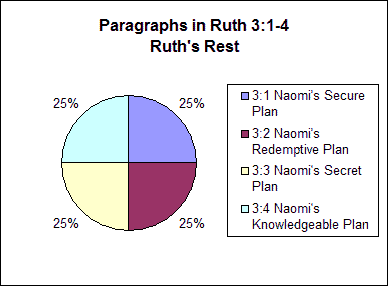
Ruth 3:1 "Naomi's Secure Plan" |
Ruth 3:2 "Naomi's Redemptive Plan" |
Ruth 3:3 "Naomi's Secret Plan" |
Ruth 3:4 "Naomi's Knowledgeable Plan" |
|
Then Naomi, her mother-in-law said to her, "My daughter, shall I not seek security for you, that it may be well with you? |
"And now is not Boaz our kinsman, with whose maids you were? Behold, he winnows barley at the threshing floor tonight. |
"Wash yourself therefore, and anoint yourself and put on your best clothes, and go down to the threshing floor; but do not make yourself known to the man until he has finished eating and drinking. |
"And it shall be when he lies down, that you shall notice the place where he lies, and you shall go and uncover his feet and lie down; then he will tell you what you shall do." |
Verse Percentage Chart for Ruth 3:1-4
|
1. Master Study |
5. Questions |
|||
The Book of Ruth, Bible Study, J. Deering, AncientPath.net, study materials are a ministry of AncientPath.net, and may be copied for use in Bible study groups, in limited numbers, providing that no charge is made for them. No further distribution or use of these materials is allowable under U.S. or International Copyright Law without the express permission of AncientPath.net. ©2008 AncientPath.net, All rights reserved.
2012-11-20